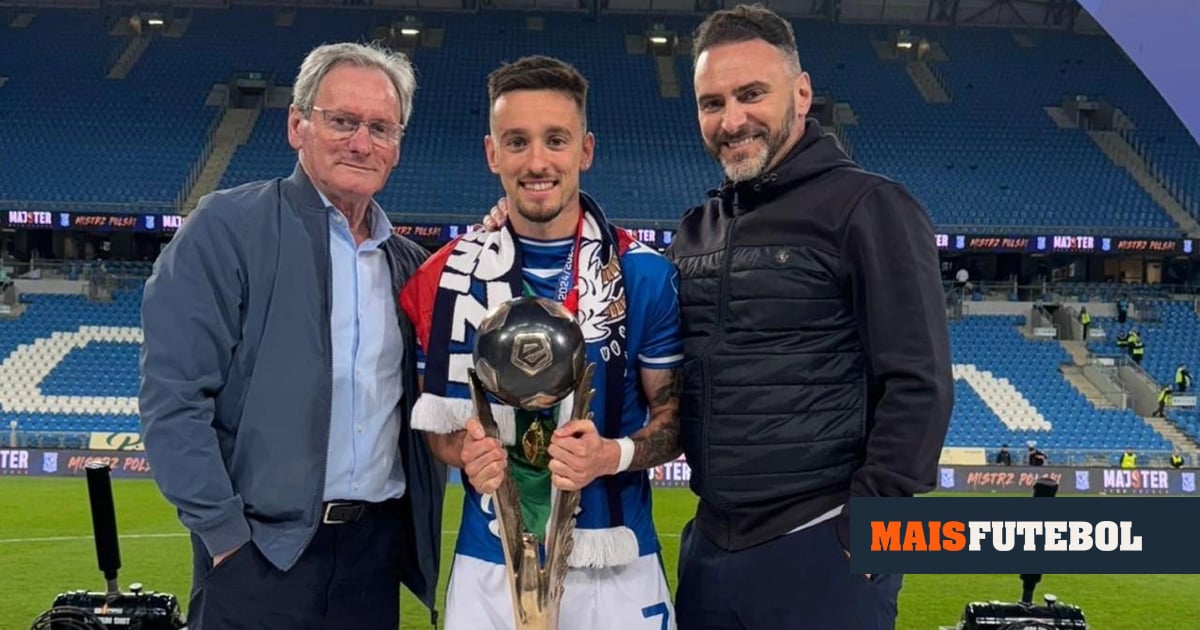
Living the first month of his 47th birthday, Ricardo Sousa – once a Beira-Mar hero at Jamor – enjoys the tranquility of Aveiro, the city in which he has lived for almost 30 years, before resuming his adventure as a coach. In a modest café in the heart of the “Venice of Portugal”, Ricardo Sousa talks to the More football and raises his hand to anyone who recognizes and greets him. He says he doesn't care about being famous, but he doesn't forget the prestige he achieved at his “heart club”. On a stormy morning – a normal day, therefore – Ricardo Sousa praises his fellow countrymen, friends and former locker room colleagues. To the More footballthis former midfielder from São João da Madeira – having trained at FC Porto and spent time at Beira-Mar, Belenenses, Santa Clara and Boavista – is studying basketball, influenced by his daughters, but his heart beats stronger for football. After all, he is the son of António Sousa and father of Afonso Sousa, a midfielder currently in Türkiye. Read also. Part I – «I'm very happy for Rui Borges' success, he's pure» Part III – «Afonso Sousa rejected a proposal from Sp. Braga in the summer» Maisfutebol: Is it easy to let go of the goal for Beira-Mar in the 1999 Portuguese Cup final? That is, your sporting image does not end at that moment. Ricardo Sousa: We always want new achievements that mark us. But Beira-Mar is the club of my heart. It is a pride to be linked to the most important achievement of the city of Aveiro. MF: He has lived in Aveiro since he was 19 years old. Do you like to go unnoticed? RS: Yes. I like being with my family, with my daughters. They both play basketball at Beira-Mar, it's the sport I follow most at the club. MF: How do you interpret Beira-Mar’s moment in football? RS: It's a sensitive phase. The clubs are subsidized by sports societies (SAD) and external support to compete in professional championships. Beira-Mar has struggled to receive investment from trusted people, which is not easy. MF: And competing in the Portuguese Championship is extremely demanding. RS: It's much more difficult to move up in the Portuguese Championship than in League 3. There are a lot of teams. When I coached Beira-Mar, in 2019/20, there were 96 teams and only two places to move up – and there are always 25 candidates. I hope Beira-Mar returns quickly to the professional championships, it is greatly missed. Even by the mass of fans. MF: For Beira-Mar they played at the Mário Duarte Stadium, a place that disappeared and was demolished. What do you feel when you pass by that place? RS: I don't like going there! I lived there for part of my childhood, I accompanied my father to training and games. Many of the best childhood and youth memories were made there. Walking down that street and looking into space is something that hurts. The stadium was hastily demolished. No work emerged. MF: At this stage when you are looking for a new challenge, do you take the opportunity to watch football with your father, the legendary António Sousa? RS: My father is the most modest person I know. It's hard to get him out of the house, he only goes out to watch my kids play. The football bug isn't going away, but it's gotten tired of modern football. It's managed differently and my father doesn't agree with many situations. He chose to walk away. The invitations continue to appear, but he doesn't want to be the protagonist. I give an example. My father supported André Villas-Boas and assured that he did not aspire to a position in the structure. Besides, my father continues to make his living and work in the tobacconist in São João da Madeira, which already belonged to my grandparents. Spend the day registering EuroMillions and talking to people. It's what he likes. He gave himself over to happiness and is in good health at 68 years old. MF: A few years ago, the coexistence of the Conceição clan in the FC Porto locker room was a topic of debate. Ricardo went through this at Beira-Mar. How is this situation managed? RS: I rarely talked about football with my father at home. I admit that it was a difficult situation, but I made it easier because of what I achieved. I won the Portuguese Cup and had good numbers. When we are important to the team, the argument of being the coach's son ends up falling apart. In the case of Sérgio Conceição's family, Francisco solved many problems and no one criticized them. But Rodrigo had less influence and was identified as a problem. Importance in the group is influential. MF: São João da Madeira, in addition to Ricardo and António Sousa, trained other players who made the “leap” to the “big ones”, such as António Veloso, Cândido Costa, Secretary or João Mário, currently at Bologna. What sets that city apart? RS: Along with Vermelhinho and Rui Correia. It's a football city, with a lot of talent. But football has changed. Before, training was almost entirely carried out in Sanjoanense. Currently, kids leave at the age of 7 or 8, which takes away the sense of belonging, the differentiating factor of each city. But Sanjoanense will continue to produce good players, as it has a lot of talent and good professionals. They know what they're doing. MF: (…) RS: The Secretary was one of the people who had the greatest impact on me at FC Porto, because we made the trip together every day. What he recently experienced reminds us of the importance of enjoying each day with the people who are most important to us. No one wants to carry the feeling that they could have done something more. MF: Ricardo was a contemporary of Cândido Costa in the formation of Sanjoanense. What is your first memory with him? RS: We were best friends, I've known him since childhood. We make a small age difference. We shared many moments in childhood and youth. Cândido's parents had a factory next to my grandmother's house. The friendship began on the street. And between the ages of 4 and 18, I spent the three months of school holidays at the Furadouro campsite, something that Cândido also did with his parents. MF: Ricardo provided the coach, Cândido opted for a different path. Was it predictable? RS: He was my assistant in my first season as coach, at Sanjoanense. And it was in that year that he started working with Porto Canal. At one point I told him: “Don’t hesitate, don’t have any doubts about what you could become”. It is with great joy that I see him thriving in a new direction. Cândido Costa and Ricardo Sousa reinforce S. João de Ver in 2012. MF: In 2001, at Belenenses, you were part of the squad that reached fifth place in the League, in the company of César Peixoto. Are you surprised by the work of Gil Vicente's coach in the current season? RS: No. César is finally getting the project he deserves. He has a team in his image. More than Gil Vicente's classification, I highlight the team's organization. It's Caesar's mirror. MF: You also shared a locker room with Fary Faye, both in Beira-Mar and Boavista. Pure coincidence? RS: Last year at Beira-Mar I made Fary the best scorer in the League [18 golos]. Then I was hired by Boavista, while Fary started the pre-season at Beira-Mar. The coach needed a striker and I proposed Fary. In other words, I end up having my share of responsibility for Fary's career at Boavista. MF: And now Fary is dealing with a very complicated situation in Boavista. RS: It's not Fary's responsibility, he wasn't ultimately responsible or the investor. Boavista's members and fans have to recognize that Fary has always stood out. He never ran away, like others, and fights so that Boavista does not disappear and can, one day, return to the level it deserves. Proceed to the third and final part of the conversation More football with Ricardo Sousa.