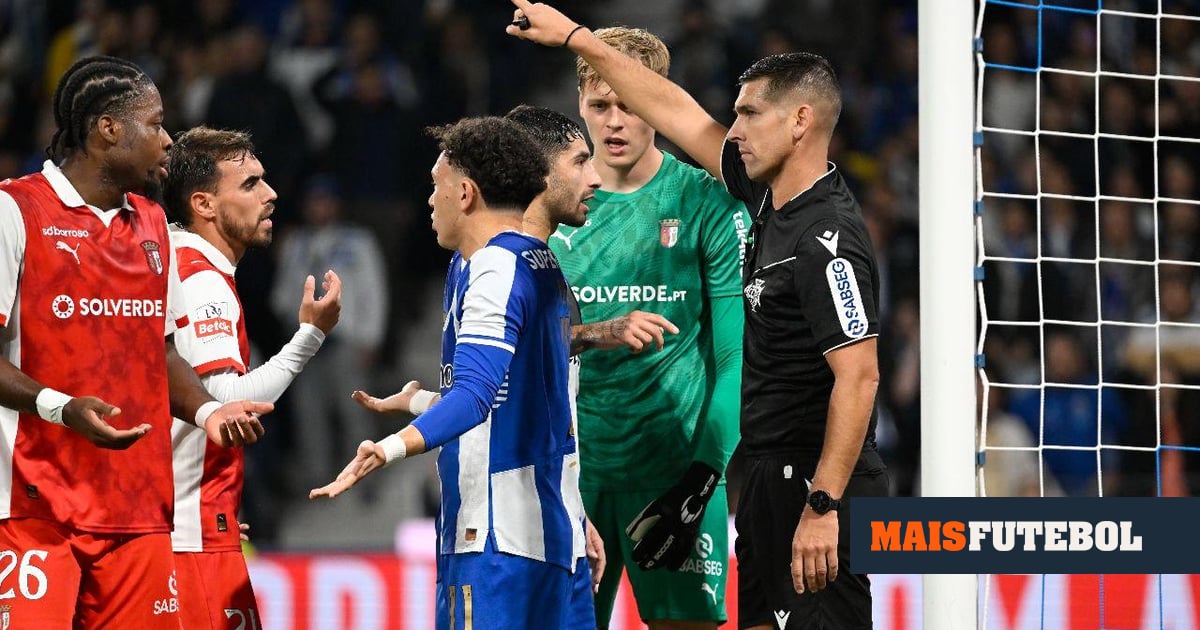
The Disciplinary Council of the Portuguese Football Federation published the ruling on the famous television case in Fábio Veríssimo's locker room, which resulted in the imposition of a fine of 12,750 euros. It is recalled that, at the time, the referee of FC Porto-Sp. Braga denounced that at half-time, images of a goal disallowed for the blue and whites in the first half of the game were shown on a loop on the aforementioned device and that the same images were shown after the game, in addition to others, of an alleged error, relating to a youth game between FC Porto and Benfica and in which Veríssimo had been involved. FC Porto's defense claimed that the images were shown in the referee's locker room by mistake. The same, the document reads, would have been requested for analysis by several “internal teams”, which would place them in the rooms where the technical team, the game analysis team and the sports management would be located”. «By mistake, when selecting the locations to inject the content, the referees' room was inadvertently selected.» FC Porto also added that the mistake occurred again after the game because it was not aware of the error previously and also stated that this was only communicated later by Fábio Veríssimo to Bertino Miranda, a former assistant referee who works at FC Porto as an advisor and trainer for the area of arbitration and game laws. The process instructor noted that Porto's SAD only limited itself to explaining how the Estádio do Dragão's content management and publishing system works, without giving any explanation about the reasons for showing these specific moments and why it happened in those time periods. «None of the Witnesses, however, was able to explain, much less in a concrete and convincing way, why there was a need to view the specific moves - one (...) referring to the game that is the subject of the case, a disallowed goal; the other related to a youth game, and validated, both refereed by Fábio Veríssimo. (...) In particular, none of the Witnesses were able to explain why a specific move - which apparently does not substantiate a technical error on the part of a player or a collective tactical failure, and which does not even reflect a pattern of play that required immediate correction (during the game in question) - had to be viewed by the Sports Directorate, the team of analysts, and the technical team (to whom the disseminated content was allegedly intended), at half-time, after the game and, as far as the latter is concerned, around forty-five minutes after the end of the game. And, above all, it was not explained why only this move was selected and shown, and not others – for example, referring to the individual or collective behavior of the players and, therefore, with undeniably greater importance in a possible tactical redefinition for the second half of the game. (...) In particular, it is still strange that at half-time - a limited time period and functionally focused on positional corrections, strategic adjustments and the possible exploitation of the opposing team's weaknesses - the technical team and game analysts chose to dedicate their time to the analysis of a single refereeing decision (a disallowed goal), without any relevance or input for the second half, and without any apparent benefit for reviewing offensive or defensive schemes», it reads. Thus, the prosecution stated that the facts described in both the referee's report and the delegate's report had been proven, in addition to the fact that the television could not be turned off using the buttons or by command as they did not work and that it did not have any visible plug for connecting to a socket, as it only had a direct connection to the ceiling. It was also proven that Fábio Veríssimo reported what happened to Bertino Miranda when the FC Porto employee went to the referees' locker room to hand over a shirt and that he himself saw the images of the tie match between FC Porto and Benfica (Torneio da Pontinha) being shown on a loop. «The Defendant Futebol Clube do Porto – Futebol, SAD acted freely, consciously and voluntarily, knowing well that his (omissive) behavior, described above, was in violation of the organizational duties that fall upon him as promoter of the sporting spectacle - and which include the assumption of responsibility for the content shown on the television installed in the referee team's locker room and for the protection of the referee team -, constituting behavior foreseen and punished by the judicial system sporting event, which resulted in serious damage to the image and good name of the football competitions, although the Defendant did not refrain from carrying it out", reads the indictment in which the instructor said she found no evidence of coercion, since the behavior of the defendant (FC Porto SAD) did not constitute a form of physical or moral violence or affect or condition the referee's work on the field. «Although this is ethically reprehensible and sportingly unacceptable and insidious behavior, it does not meet the elements of the type of illicit coercion of members of the refereeing team.»