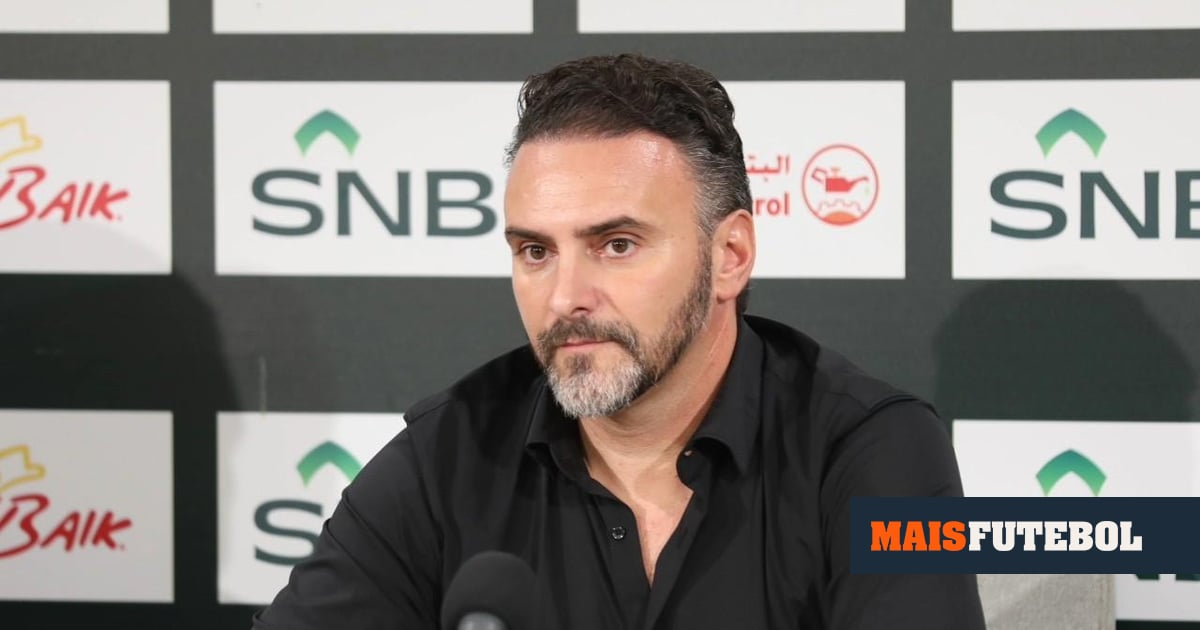
Living the first month of his 47th birthday, Ricardo Sousa – once a Beira-Mar hero at Jamor – enjoys the tranquility of Aveiro, the city in which he has lived for almost 30 years, before resuming his adventure as a coach. In a modest café in the heart of the “Venice of Portugal”, Ricardo Sousa talks to the More football and raises his hand to anyone who recognizes and greets him. He says he doesn't care about being famous, but he doesn't forget the prestige he achieved at his “heart club”. On a stormy morning – a normal day, therefore – Ricardo Sousa addresses the sudden departure of Vizela's technical command and regrets the moment of the Minho team. At the same time, he praises former players, locker room colleagues and Rui Borges, from Trás-os-Montes who succeeded Sousa at Mafra in 2023. To the More footballthis former midfielder from São João da Madeira – having trained at FC Porto and spent time at Beira-Mar, Belenenses, Santa Clara and Boavista – is studying basketball, influenced by his daughters, but his heart beats stronger for football. After all, he is the son of António Sousa and father of Afonso Sousa, a midfielder currently in Türkiye. Read also. Part II – «My father gave himself up to happiness, he got tired of modern football» Part III – «Afonso Sousa rejected a proposal from Sp. Braga in the summer» Maisfutebol: Left Vizela at the beginning of December. How do you describe the moment you are living in? Is it looking for new destinations, or calming down? Ricardo Sousa: We must always be prepared for what comes next. It's difficult for me to be without football, because I like being in the competition. I'm waiting for an opportunity, whether in Portugal or abroad. I already had a survey to return to work at the beginning of January, in the II League, but the negotiations did not progress. I look forward to a proposal that pleases me. I would like to continue in Portugal, in a project that gives me the conditions to fight for what I want. MF: (…) RS: In the first few weeks there is calm, focusing on the family, on what we cannot give while we are working. Then there is reactivation, trying to improve what we dream of being. MF: Vizela aims to return to the League. What remained to be done? RS: Honestly? I don't even know. I accepted a difficult project. It's a big and organized club, with a strong and demanding fan base, but eight starters left compared to last season. As imposed by the management, I assumed the objective of moving up to the League. This made the project difficult. But the truth is that we were one of the best teams on the 13th round, we were two points behind third place. The departure was a surprise. The decision came from the club. I was lucky and fortunate to work with a sports director who knows a lot about football – Toni Dovale [antigo jogador do Celta de Vigo] – it’s difficult to find a professional like him. I wish there were big teams. He was the one who allowed me to have a cohesive and quality group. Despite the departures in the summer and the injuries, we were within our objective. Since I left, Vizela has won two in eight games. This situation causes hurt. I created a great affinity with the group. They complied with everything he said and were willing to listen. MF: How do you analyze the competitiveness of the II League? RS: It is one of the most competitive championships in the world, the teams are evenly matched. There are many candidates for the climb. And we look at Farense, a supposed candidate, but, after all, in the fight to stay. These are factors that attract people to stadiums and that boost Portuguese football. MF: At what point did you realize you would pursue a career in coaching? RS: From an early age. I started to see football differently, from an early age I started to draw conclusions about the positives and negatives of each coach – starting with the training ideology and attitude. And I was aware of the difficulty of this life. MF: He was trained by António Sousa at Beira-Mar. What do you take from your father as a coach? RS: The way he welcomed and united the groups. The players were always with him, even if they didn't play. My father was always sincere and serious. It's difficult to manage large groups, whether because of nature or because you want to play more. My father always knew how to lend a hand and, therefore, have the group at hand. I also feel capable of doing it. MF: As a midfielder, Ricardo was coached by Manuel Fernandes at Santa Clara, in 1999/00. What happened to this coach? RS: A special man. He always had advice, based on what he experienced. He gave examples in every lecture, which gave me the strength to follow this path. He is, alongside my father, the player with the most appearances in the League. I've faced Manuel Fernandes' son – Tiago Fernandes – and they're different, Tiago is more of a strategist. Thanks to our parents' relationship, Tiago is a childhood friend. MF: At Beira-Mar, in 2019/20, you trained Carlos Daniel, a midfielder currently at Marítimo who is having one of the best seasons of his career. RS: That season we played against Fátima and I loved Carlos, he had a lot of assists and an eye for goals. Unfortunately, I hired him during the pandemic. Beira-Mar was fighting for promotion to the II League. Years later, I coached Carlos at Mafra, already in the II League. He continues to have superlative technical quality, he knows how to be a “10” with a very keen eye for goals. It is with satisfaction that I see Carlos emerge. Despite being 31 years old, he has had good seasons and was one of the pillars of Nacional's rise in 2023/24. This season he has better numbers because he plays closer to the area. MF: Ricardo spent three seasons at Mafra and reached the semi-final of the Portuguese Cup. Was this the most stable phase of your journey as a coach? RS: Undoubtedly. I reached the unprecedented semi-final of the Cup – there is a little regret, due to the game in Tondela – and we reached the best classification in the II League. I loved being there, with fantastic fans. In the clubs where I trained, I always achieved my goals. In the year of Feirense (2023/24), in a very difficult season – two months without access to training and game facilities – I left with the club within the proposed objective. A month before leaving Feirense I received an offer from a II League club that was fighting for promotion – and financially very stable. But Feirense didn't release me, renewed it and, a month later, fired me. These are difficult situations to accept. It's modern football. You have to have hope. MF: At Mafra he worked with Samu Silva, starting goalkeeper and captain at Marítimo. What do you remember about him? RS: Samu was hired from Desp. Chaves, where he was the third goalkeeper. Few people believed in him, but he was a starter at Mafra. I chose to alternate goalkeepers, because both Samu and Dida [Renan Bragança] They were two enormous professionals. At that stage, I noticed that Samu had an above-average capacity. Therefore, he can still reach much higher in Portuguese football, especially due to his human qualities. As a goalkeeper he is a monster between the posts and knows how to play with his feet. I identify few weaknesses in it. He's not two meters tall, but he adds a lot of quality to the team. I'm sure he'll reach a reference team in the League. MF: When he left Mafra, he was replaced by Rui Borges, current Sporting coach. Are you surprised by this Trás-os-Montes route? RS: I already knew Rui. He trained Mirandela and I trained Felgueiras, in the Portuguese Championship. It was clear that Rui had the capacity for much more. In the II League I faced him when he was coaching Académico de Viseu. And later at Nacional. His teams were always organized, he was always a difficult opponent. I'm very happy for Rui's success. He deserves it. It's pure. Proceed to the second part of Ricardo Sousa's conversation with the More football.